
Editor’s Note: This is part two of a two-part series, A Non-Sticky Situation, that examines perfluorinated compounds or “Teflon chemicals,” in Puget Sound. Part one looked at why the characteristics of Teflon chemicals make them problematic for the fish and wildlife of Puget Sound. It is part of a series of posts delving into some of the the chemical pollutants that have contaminated Puget Sound’s fish and wildlife and pose one of the greatest threats to their survival.
In 2008, the University of Washington – Tacoma and its Center for Urban Waters were fortunate enough to recruit Dr. Joyce Dinglasan-Panlilio to join its faculty. A chemist hailing from the Mabury group in Toronto, Dinglasan-Panlilio possessed extensive expertise in PFCs and a desire to use that expertise in the Pacific Northwest. And in 2010, the Center, together with the City of Tacoma, was able to provide funding to purchase the instrument she needed to measure PFCs in our local environment and learn more about where they’re coming from.
Dr. Dinglasan-Panlilio and her student Shristi Prakash have now completed an initial survey of PFCs in Puget Sound, finding them in our local marine waters for the first time. In fact, they found PFCs in every sample tested, from a low of 5 nanograms per liter (ng/L) in Hood Canal to a high of 41 ng/L in First Creek, Puyallup[1]. These levels are similar to those found by the Washington State Department of Ecology in its 2010 survey of the state’s surface waters, which found PFCs in several rivers in the Puget Sound basin, as well as Lake Washington, the Columbia River, and the Spokane River[2].
Much higher levels were detected in wastewater treatment plant effluent, suggesting they are a major pathway for PFC transport to Puget Sound. Surprisingly, previous studies examining wastewater treatment plants have found that unlike other toxics that are reduced in concentration by the treatment process, PFOA and PFOS levels actually increase significantly[3]. Apparently, PFCs in the wastewater stream—such as PFCs from “stain-resistant” carpet treatments and other products—are breaking down in the treatment process to the very long-lived, toxic PFOA and PFOS as well as other persistent chemicals. Other research has found PFCs in street runoff, suggesting that outdoor uses of the compounds are leading to pollution as well[3, 4].
Stain Resistant Fish and Wildlife
While research on the effects of PFCs on fish and wildlife has been relatively minimal, some studies show cause for concern. Laboratory studies on fish and fish cell cultures indicate that PFOA may lead to inflammation and other potentially damaging changes at the cellular level[5-7]. The chemical also caused tumors in laboratory tests on trout, and can exert an estrogenic effect, feminizing male fish[6, 8].
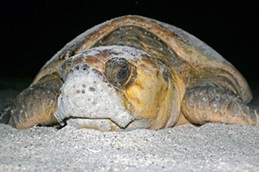 Some studies indicate that harmful effects may be taking place at the levels currently in the environment. For example, wild loggerhead sea turtles with higher levels of PFCs had indications of liver dysfunction; contaminant levels were also associated with immune function[9]. And an extensive study of river otters along the California Coast found that those that died of infectious disease had higher levels of PFCs, suggesting they may negatively affect the immune systems of wild animals[10].
The concern is, if we know they’re persistent and we know they’re bioaccumulative, then if we don’t find out where they’re coming from, that the compounds will eventually end up increasing to the levels where we see toxic effects. -Dr. Joyce Dinglasan-Panlilio
In many ways, our understanding of Teflon chemicals remains in its infancy. The number of research articles on the chemicals has quadrupled in the last five years, but much remains unknown about how they move and act in the environment. Locally, with the leadership of Dr. Dinglasan-Panlilio and scientists at the state Department of Ecology, a more intensive focus on these chemicals in the Puget Sound food web will begin to shed light on their impacts. In the meantime, with no regulation of these compounds, manufacturers will continue to make use of their amazing chemical properties in everything from windshield wiper fluid to carpet treatments, with most users unaware of the consequences for fish, wildlife, and people.
Photo Attributions:
Loggerhead sea turtle courtesy of Flickr user USFWS/Southeast
Notes:
- Prakash, S., JE Baker, and MJ Dinglasan-Panlilio, Perfluorinated acids in surface waters from Puget Sound, in PNW-SETAC 20th Annual Meeting. 1011: Vancouver, WA.
- Furl, C., and C Meredith, Perfluorinated compounds in Washington rivers and lakes. 2010, Toxic Studies Unit, Environmental Assessment Program, Washington State Department of Ecology: Olympia.
- Murakami, M., H Shinohara, and H Takada, Evaluation of wastewater and street runoff as sources of perfluorinated surfactants (PSS). Chemosphere, 2009. 74: p. 487-93.
- Kim, S.-K., and K Kannan, Perfluorinated acids in air, rain, snow, surface runoff and lakes: relative importance of pathways to contamination of urban lakes. Environmental Science and Technology, 2007. 41: p. 8328-8334.
- Yang, J.-H., Perfluorooctanoic acid induces peroxisomal fatty acid oxidation and cytokine expression in the liver of male Japanese medaka (Oryzias latipes). Chemosphere, 2010. 81.
- Kim, W.-K., S-K Lee, and J Jung, Integrated assessment of biomarker responses in common carp (Cyprinus carpio) exposed to perfluorinated organic compounds. Journal of Hazardous Materials, 2010. 180: p. 395-400.
- Liu, C., K Yu, X Shi, J Wang, PKS Lam, RSS Wu, and B Zhou, Induction of oxidative stress and apoptosis by PFOS and PFOA in primary cultured hepatocytes of freshwater tilapia (Oreochromis niloticus). Aquatic Toxicology, 2007. 82: p. 135-143.
- Tilton, S., GA Orner, AD Benninghoff, HM Carpenter, JD Hendricks, CB Pereira, and DE Williams, Genomic profiling reveals an alternate mechanism for hepatic tumor promotion by perfluorooctanoic acid in rainbow trout. Environmental Health Perspectives, 2008. 116(8): p. 1047-1055.
- Peden-Adams, M., DE Keil, T Romano, MAM Mollenhauer, DJ Fort, PD Guiney, M Houde, K Kannan, DC Muir, CD Rice, J Stuckey, AL Segards, T Scott, L Talent, GD Bossart, PA Fair, and JM Keller, Health effects of perfluorinated compounds—What are the wildlife telling us? Reproductive Toxicology, 2009. 27: p. 409-410.
- Kannan, K., E Perrotta, and NJ Thomas, Association between perfluorinated compounds and pathological conditions in southern sea otters. Environmental Science and Technology, 2006. 40(16): p. 4943-4948.