

Editor’s Note: Today, as part of our new Clean and Healthy Waters Campaign, we begin a series of posts delving into some of the chemical pollutants that have contaminated Puget Sound’s fish and wildlife and pose one of the greatest threats to their survival. We start with a three-part series, A Fireproof Puget Sound, on toxic flame retardants, made famous by the sudden rise in levels of the flame retardant PBDEs in the 1990s.
Birth order may be even more important for whales than for people. In 2003, killer whale J38 was born five years after his older brother, his mother’s firstborn. While big brother probably got the biggest share of their mom’s pollutant load, in those five years her fish-rich diet reloaded her with enough PCBs, DDTs, and PBDEs to make J38 a standout for his toxic burden[1].
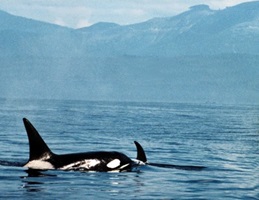
In fact, J38’s mom passed enough of these toxic, persistent chemicals on to her son that his load exceeds hers by at least ten times for most chemicals. How did she do this? Through the course of pregnancy and nursing, much of her own body burden of these chemicals transferred to his blubber and other parts of his body. But with his much smaller body weight, the concentrations wound up much higher.
PCBs and DDT were banned in the 1970s, but not before the use of very large quantities that haunt Puget Sound orcas today. Polybrominated diphenyl ethers, the toxic flame retardants better known as PBDEs, came into use in the 70s, and by 2001 were used in quantities of more than 30,000 metric tons each year in the United States to flameproof televisions, furniture, and other items[2]. Because they, like PCBs and DDT, last a long time in the environment and build up in animals, top predators like orcas serve as prime guinea pigs as we learn of the effects of these chemicals.
It’s hard to test orcas in the lab, but researchers have looked at the effects of PBDEs on salmon and other fish. The results are not encouraging. After 10 days of PBDE exposure, fathead minnows (a typical laboratory test fish) stopped spawning completely[3]. In another study, scientists looked at the effects of PBDEs on the similarly structured thyroid hormone T4, and found lower hormone levels in PBDE-exposed lake trout[4]. And this year, scientists from Seattle’s Northwest Fisheries Science Center published particularly troubling research: juvenile salmon exposed to PBDEs at levels similar to those in the Willamette River were more susceptible to lethal infection, suggesting that the chemicals are interfering with their immune response[5].

Research on harbor seals and other mammals also indicates an impact on the immune system from PBDEs and PCBs. Captive harbor seals fed a diet from a contaminated area suffered problems with their reproductive and immune systems[6].
Orcas are even higher on the food chain, with our resident whales feeding primarily on salmon as well as other contaminated fish. Tests of Puget Sound fish found that Chinook salmon, their very favorite food, had the highest PBDE levels[7]. We don’t fully understand the impact of PBDEs on Puget Sound orcas, but their PCB levels are higher than levels that caused reproductive, immune system, and thyroid effects in harbor seals[6].
As with PCBs, the physical properties of PBDEs make them perfectly suited to build up in animals. After first finding them in the environment in 1981 in Sweden, scientists discovered in the 1990s that levels in the environment and in fish and wildlife were increasing at an exponential rate. Puget Sound’s fish and marine mammals were unfortunately no exception[6].
The Puget Sound orca population suffered a steep decline of 20% between 1996 and 2001—likely in part due to their load of chemicals like PCBS and PBDEs. Hardest hit were juveniles, adult males, and post-reproductive females, the same whales that show the highest toxic body burdens. Our local experts hypothesize that as Chinook salmon populations faltered in the 1990s, Puget Sound orcas used up some of their fat stores and thereby increased the contaminant load in their blood, making them more vulnerable to disease[1].
While 2009 and 2010 brought a mini baby boom for our local orca population, it remains to be seen how the PBDEs and other toxic chemicals they started life with will affect their survival.
Photo Attributions:
Paddleboarding on Puget Sound courtesy of Nancy Stoffer
Harbor seal courtesy of Flickr User hj_west.
Notes:
- Krahn, M., MB Hanson, GS Schorr, CK Emmons, DG Burrows, JL Bolton, RW Baird, and GM Ylitalo, Effects of age, sex, and reproductive status on persistent organic pollutant concentrations in “Southern Resident” killer whales. Marine Pollution Bulletin, 2009. 58: p. 1522-1529.
- Washington Department of Ecology, Washington Department of Health, Washington State Polybrominated Diphenyl Ether (PBDE) Chemical Action Plan. 2005.
- Muirhead, E., AD Skillman, SE Hook, and IR Schultz, Oral Exposure of PBDE-47 in fish: Toxicokinetics and Reproductive Effects in Japanese Medaka (Oryzias latipes) and Fathead Minnows (Pimephales promelas). Environmental Science and Technology, 2006. 40: p. 523-528.
- Tomy, G., VP Palace, T Halldorson, E Braekevelt, R Danell, K Wautier, B Evans, L Brinkworth, and AT Fisk, Bioaccumulation, Biotransformation, and Biochemical Effects of Brominated Diphenyl Ethers in Juvenile Lake Trout (Salvelinus namaycush). Environmental Science and Technology, 2004. 38: p. 1496-1504.
- Arkoosh, M., D Boylen, J Dietrich, BF Anulacion, G Ylitalo, CF Bravo, LL Johnson, FJ Loge, and TK Collier, Disease susceptibility of salmon exposed to polybrominated diphenyl ethers (PBDEs). Aquatic Toxicology, 2010. 98: p. 51-59.
- Ross, P., Fireproof killer whales (Orcinus orca): flame-retardant chemicals and the conservation imperative in the charismatic icon of British Columbia, Canada. Can J Fish Aquat Sci, 2006. 63: p. 224-234.
- O’Neill, S., JE West, GM Ylitalo, CA Sloan, MM Krahn, and TK Collier, Concentrations of polybrominated diphenyl ethers (PBDEs) in fish from Puget Sound, WA, USA, in SETAC World Congress and 25th Annual Meeting in North America Society of Environmental Toxicology and Chemistry. 2004: Portland, OR.

Science Director
Erika Schreder leads Toxic-Free Future’s scientific research program, developing strategic investigations to advance the organization’s goals.